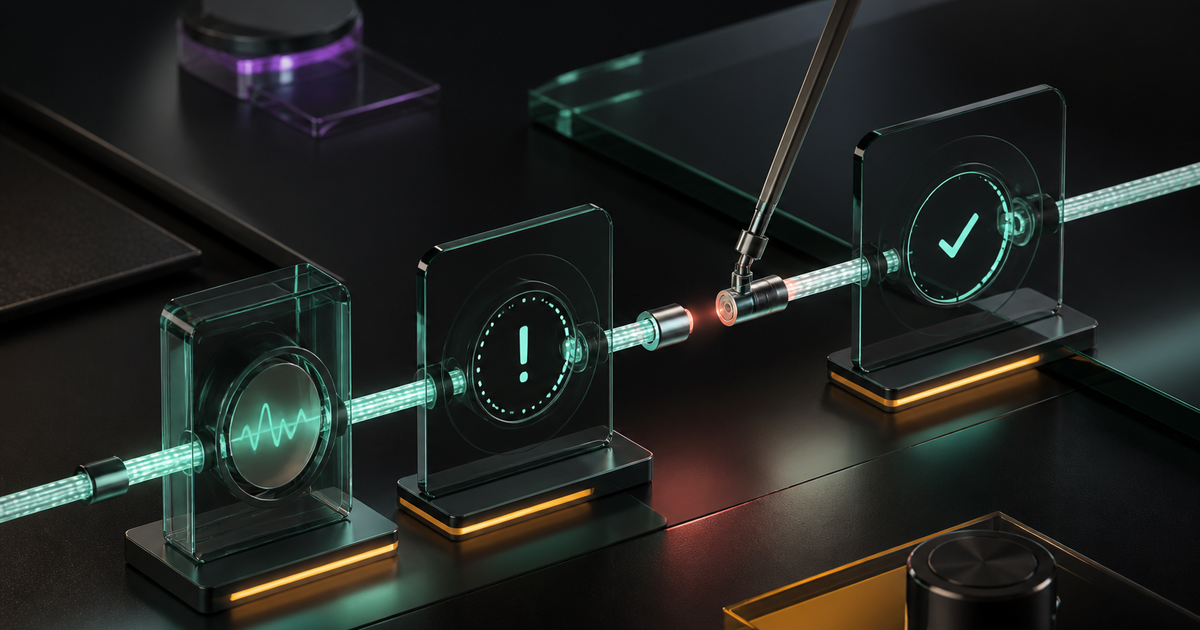
Green artifacts on a stream, or blocks of smeared and broken picture, start in one of three places. It's the source, the encoder, or the platform's support for the codec you sent. Find which one before changing settings. Look at the OBS preview, then a short local recording made with your streaming encoder, then the stream as viewers see it. The first place the corruption appears is where to fix it.
OBS's documentation has no page on green video, and we haven't reproduced it. This page uses what OBS, YouTube and Kick do document and says where that runs out. Other picture problems are covered in the stream troubleshooting guides.
Green blocks or a green fringe around you?
Two different problems get searched with the same words. This page is about video that turns green, smears or breaks into blocks: a fault in a source, the encoder or the codec. Maybe you use a physical green screen and the artifacts are a green edge around your hair, flickering patches or a background that won't key out cleanly. That's the Chroma Key filter and your lighting. The chroma key guide covers those settings.
A quick way to tell them apart: hide the camera source with the chroma key on it. If the green goes with it and the rest of the scene is clean, it's keying. If green still flashes over the game or the whole frame, read on.
Where do the green screen artifacts appear first?
| Corruption is visible in | Points to | Start with |
|---|---|---|
| The OBS preview, on one source | That source | The source's own settings |
| A local recording, but not the preview | The encoder | Driver, then another encoder |
| Viewers only | The codec or the platform | What the platform accepts |
To make the recording test fair, set the recording to use the same encoder as the stream. In Advanced output mode that's (Use stream encoder) as the recording encoder; in Simple mode, Same as stream. Ten seconds of a moving scene is enough.
One source is broken in the preview
Then encoding isn't involved yet, because the preview is drawn before the encoder. Look at that source's properties.
- Capture cards and webcams: the OBS Knowledge Base lists Video Format, Color Space and Color range on the Video Capture Device source, all on default settings at first. Change one at a time. If the card's own picture is wrong, start with the capture card guide.
- Video files in a Media Source: OBS 33.0.1 has Use hardware decoding when available in the source's properties. Turn it off for a test to see whether the graphics chip's decoder is the problem.
- A captured window: if only one app looks wrong and the rest of the scene is clean, see the window capture guide for the capture methods OBS offers.
The recording is corrupted too
If the preview is clean and the recording isn't, the encoder output is damaged. Update the graphics driver first. OBS's own error text for a failed start tells NVENC and AMD encoder users to make sure their video drivers are up to date. Its NVENC checks include a reason labeled Outdated driver.
A driver update doesn't always fix it. In an OBS forum thread about green lines with NVENC H.264 on an older laptop, the poster says the lines disappeared with QuickSync H.264 or x264. Reinstalling the GPU driver, and a clean reinstall with DDU, didn't help. A forum regular suggested a hardware fault, and the thread ended without a fix.
Then switch the encoder to x264, which runs on the processor, for one test recording. If the corruption goes, the hardware encoder or its driver is at fault. x264 costs CPU, so treat it as a test rather than a permanent setting unless your processor has room. The performance guide has the trade-off.
If OBS shows An encoder error occurred while streaming, or the same while recording, the encoder stopped outright. The output failed guide covers reading the log for that. If a finished recording stutters rather than showing green, that's a different fault, covered in the recording stutter guide.
Color format, color space and HDR settings
Settings, Advanced, Video holds three options that change what the encoder receives: Color Format, Color Space and Color Range. If you changed any of them and the trouble started after, they're the first suspects.
OBS 33.0.1 shows a warning when Color Format is set to anything other than NV12 or P010. It says other formats are primarily intended for recording and not recommended when streaming. So I444, which looks tempting because it keeps full color detail, belongs in recordings, not streams.
YouTube's encoder settings page lists Rec. 709 and 8-bit for SDR. For HDR it lists 10-bit and H.265 (HEVC), and says AV1 isn't supported for HDR. If you've been experimenting with Rec. 2100 (PQ) or Rec. 2100 (HLG), set Color Format to NV12 and Color Space to Rec. 709 for one test stream. Clean video in that test means the HDR combination was the problem.
The virtual camera turns green in a meeting app
The same symptom shows up in the OBS virtual camera, where no streaming encoder is involved. A long OBS forum thread covers virtual camera output going green and distorted. Users there report that setting OBS's output resolution to 1920x1080 at 30 fps fixed it for them in Microsoft Teams. One says it happened at 1280x720 every time in Teams and never in other apps. Another already ran 1920x1080 at 30 fps and still had it. Restarting the virtual camera inside Teams fixed it for one user, who didn't count that as a long-term fix.
Those are user reports, not documented behavior. They're cheap to test: match the output resolution and frame rate to what the meeting app expects, then restart the virtual camera. If the camera doesn't appear in the app at all, see the virtual camera troubleshooting guide.
Only viewers see it
If your preview and recording are clean, check the codec against what the platform accepts. Kick's help center says it currently supports only x264 or H.264. YouTube lists H.264, H.265 (HEVC) and AV1 for live encoders. Its stream health messages include Please set the video codec for the stream to H.264 when a stream doesn't fit the configuration. Check the Live Control Room or your platform's equivalent for messages while the problem is happening.
Stutter, freezing and blur during movement are a different fault from green blocks. If you stream over wireless, the Wi-Fi guide covers the connection side.
Neither platform says what a viewer sees when an unsupported codec gets through. Our view: if you've switched to HEVC or AV1 recently and the trouble started then, go back to H.264 for one stream before trying anything else. It's the quickest way to rule the codec in or out.
Corrupted video questions
Why does NVENC put green lines in my recording?
If the preview is clean, the encoder output is the suspect, so update the graphics driver first. In one OBS forum thread, green lines appeared only with NVENC H.264 and went away with QuickSync H.264 or x264, while a clean driver reinstall didn't help. If switching encoders fixes it, stay on the working encoder and check the GPU itself.
Why does my OBS virtual camera turn green in Teams?
OBS doesn't document a cause. Users in an OBS forum thread report the green distortion stopped at an output resolution of 1920x1080 and 30 fps. One says it appeared every time at 1280x720. Another user had it at 1920x1080 too, so it isn't a sure fix. Match the output to what the meeting app supports, then restart the virtual camera.
Why is my stream green but the OBS preview looks fine?
The preview is drawn before encoding, so the fault is in the encoder output or in what the platform accepts. Make a short recording with the stream encoder. If it's green too, update the graphics driver and test x264. If it's clean, check the codec against the platform's requirements.
How do I find where green video corruption starts?
Check the OBS preview, then a short recording with the stream encoder, then the live stream. The first place it shows is where to fix it.
Is green on my stream a chroma key problem?
Hide the keyed camera. If the green goes with it, it's keying; if it still flashes over the game, it's a source, encoder or codec fault.
Can hardware decoding cause green video in OBS?
It can for media files. Turn off Use hardware decoding when available in the Media Source for a test.
Should I stream with I444 color format in OBS?
No. OBS warns that formats other than NV12 and P010 are meant for recording, not streaming.
Which codec does Kick accept?
Only x264 or H.264. If you switched to HEVC or AV1, go back to H.264 for a test stream.
Can HDR settings corrupt my OBS stream?
They can. Set Color Format to NV12 and Color Space to Rec. 709 for one test stream to rule them out.
Does updating my GPU driver fix green encoder lines?
It's the first step. If not, test a recording with x264 to see whether the hardware encoder is at fault.
Sources and checks
10 sources, checked November 15, 2026
Platform and app documentation changes. These sources were checked on the dates shown.
- OBS Studio locale: frontend/data/locale/en-US.ini, checked November 12, 2026
- OBS Knowledge Base: Video Capture Sources, checked November 13, 2026
- OBS Studio 33.0.1 locale: frontend/data/locale/en-US.ini, checked November 15, 2026
- OBS Studio 33.0.1 locale: plugins/obs-ffmpeg/data/locale/en-US.ini, checked November 15, 2026
- OBS Forums: NVENC H.264 causing green lines on video, checked November 15, 2026
- OBS Forums: Virtual Cam output gets distorted and turns greenish, checked November 15, 2026
- Kick Help: How to stream on KICK.com, checked November 15, 2026
- YouTube Help: Choose live encoder settings, bitrates, and resolutions, checked November 15, 2026
- YouTube Help: Live streaming error messages, checked November 13, 2026
WaveSync app and source checks cited on this page:
- OBS Studio 32.2.2 Media Source label Use hardware decoding when available, read from the installed app on the WaveSync test Mac on 5 November 2026.
WaveSync makes the interactive side easy
WaveSync plays sounds, runs games and reads chat aloud when viewers send gifts or type a command. Every setting is a click or two away, and the Free plan needs no card.
See how WaveSync works →